
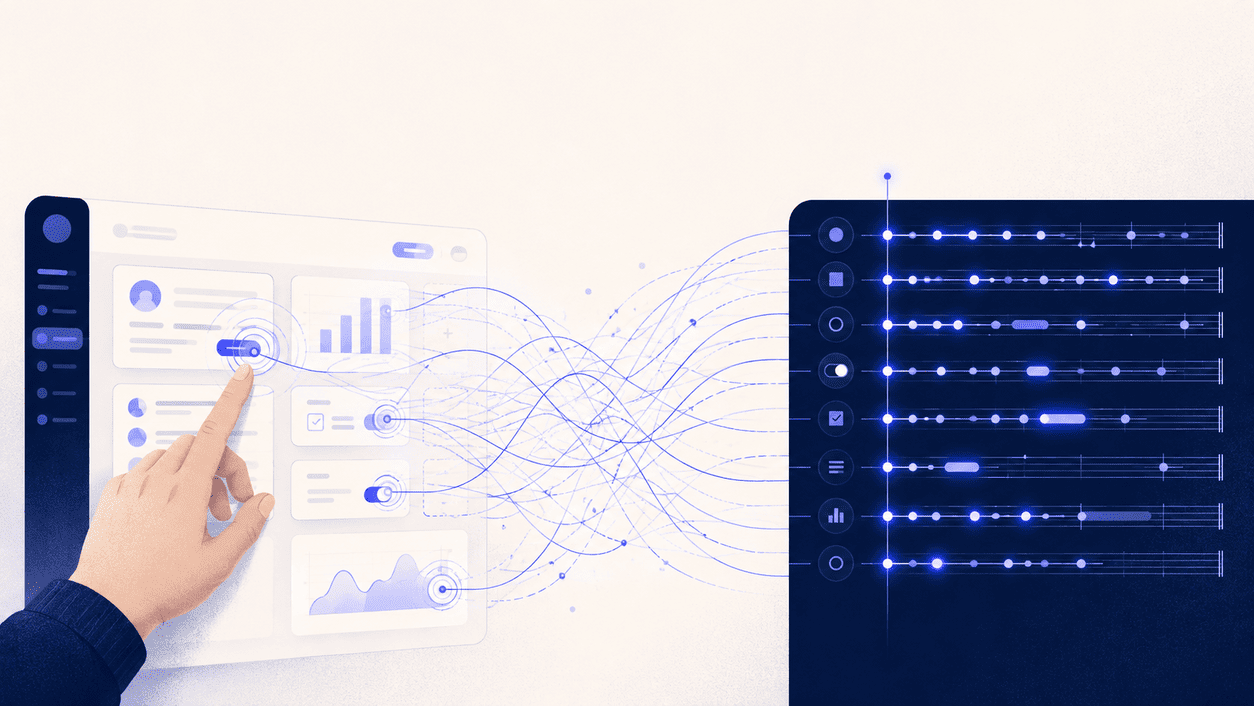
There is a term moving from robotics labs into software right now: visual imitation learning, teaching a machine to perform a task by showing it a human doing that task, instead of programming it rule by rule. In robotics it means an arm learning pick-and-place from a single video of a person's hands. In software it will mean agents learning your tools by watching your experts. Either way, the entire approach rests on one input: a good demonstration. That input is what stepvideo has been building all along.
What is visual imitation learning?
Visual imitation learning is a branch of machine learning where the training signal is a demonstration rather than a dataset of labeled examples or a hand-written rulebook. A human performs the task; the system extracts what happened, meaning which objects were touched, in what order, with what result, and turns that structure into something a machine can reproduce. Recent research has pushed this to one-shot learning, where a single demonstration video becomes a repeatable, generalizable skill.
The under-appreciated part is where these systems struggle. It is rarely the learning. It is the seeing, recovering what actually happened from raw pixels. Perception from video alone is fragile: hands occlude objects, small targets get missed, and every downstream step inherits the guesswork. The research answer is more elaborate perception. The engineering answer is better: instrument the environment so you never have to guess.
Documentation describes work. Demonstrations are work.
Most companies try to transfer expertise through documentation: wikis, PDFs, help centers. Documentation is a description of work, written after the fact, drifting out of date from the day it is published. A demonstration is the work itself: the real expert, the real interface, the real order of operations, including the hundred small decisions no one thinks to write down. People have always learned better from watching. It turns out machines do too.
Documentation is what someone remembers about the work. A demonstration is the work. We built stepvideo on the second one, and the AI era is proving that bet right.
Ground truth beats pixel guessing
The distinction that matters technically is where the action data comes from. When a system learns from a plain screen recording, it must infer the actions from pixels: was that a click or a hover, which element received it, did the page change because of the click or on its own? Every answer is a probability. stepvideo's recorder sits in the browser with the workflow, so it does not infer. It records the interaction events themselves: each click, each keystroke burst, each navigation and scroll, each timestamped against the same clock as the video frames and the narration.
| Screen recording alone | stepvideo capture | |
|---|---|---|
| What a click is | A guess from pixel changes | A recorded event with a timestamp and a target |
| Order of actions | Inferred, sometimes wrongly | The order they actually happened |
| What the machine gets | Video it must decode | Video plus the structured truth beside it |
| What a human gets | Raw footage to edit | A narrated, zoomed, captioned tutorial, automatically |
This is the same lesson the robotics literature keeps learning at the perception layer: event detection is winnable, and pixel-perfect inference is not the hill to fight on. We chose the event side of that trade years before it was fashionable.
One take, two artifacts
Record a workflow once with stepvideo and you get a finished tutorial for humans, cut, zoomed to the action, narrated, captioned and translated, and, from the very same take, a structured record of the demonstration: every step, every action, every timestamp. For your new hire it is a how-to video. For a machine it is a high-resolution trace of how your best person actually does the job.
We are now taking that structure one level deeper. Our next engine release binds every narration sentence to the specific recorded events it describes, and refuses a script whose story disagrees with the recorded order of events. The narration stops being prose that sits near the video and becomes an annotation layer over the demonstration itself, checkable and checked.
Every stepvideo is a demonstration a machine could learn from. We know which events happened, in which order, and which sentence of narration describes each one. That is the data structure, not a marketing metaphor.
How to build a demonstration library
You do not need a research team to put this idea to work. The playbook is the one we watch our best customers run, and it doubles as plain good process documentation:
- 1
List the workflows people ask about twice
If someone has explained it in a call more than once, it is a candidate. Support answers, onboarding flows, and the fiddly monthly tasks nobody volunteers for are the highest-yield starting set.
- 2
Record the expert doing the real thing
Not a rehearsed performance, but the actual task on the actual tool. The hesitations and small corrections are information, and the recorder captures the events either way.
- 3
Let the engine do the production work
Cutting, zooming to the action, narration, captions and the step-by-step document all come from the take itself. The expert's time cost is the length of the task, nothing more.
- 4
Publish where the question gets asked
A video knowledge base beats a wiki page because the answer shows itself. Every view is a call that did not happen.
- 5
Keep every take
The library you accumulate is the asset. Each recording is a demonstration with its event record intact, the exact raw material the next generation of workplace AI will be hungry for.
Where we deliberately stop
Plenty of companies are racing to ship agents that act inside your accounts. We are deliberately not one of them today. stepvideo never clicks anything on your behalf; it makes expert work legible to people immediately, and to machines whenever you decide that is what you want. Understanding first, execution only ever on your terms. If the industry gets agents right, the teams who recorded their expertise will hand it to those agents in an afternoon. The teams who only wrote documentation will be starting over.
Frequently asked questions
What is visual imitation learning in simple terms?
It is teaching a machine to do a task by showing it a human demonstration, often a video, instead of programming rules or labeling thousands of examples. The system extracts what happened in the demonstration and learns to reproduce it.
Does stepvideo train AI agents to use my software?
No. stepvideo records and explains workflows; it never acts inside your accounts. What it produces, meaning tutorials for people and structured event records of each demonstration, is the kind of ground truth agent systems need, available to you whenever you choose to use it that way.
How is a stepvideo capture different from a normal screen recording?
A normal recording is only pixels, so any system reading it must guess what happened. stepvideo records the interaction events themselves, meaning clicks, typing, navigation and scrolls, timestamped alongside the video and narration, so nothing about the workflow has to be inferred.
What do I get from one recording?
A finished tutorial (cut, zoomed, narrated, captioned, translatable into other languages) plus a step-by-step document, and underneath both, a structured, timestamped record of the demonstrated workflow, all from a single take.